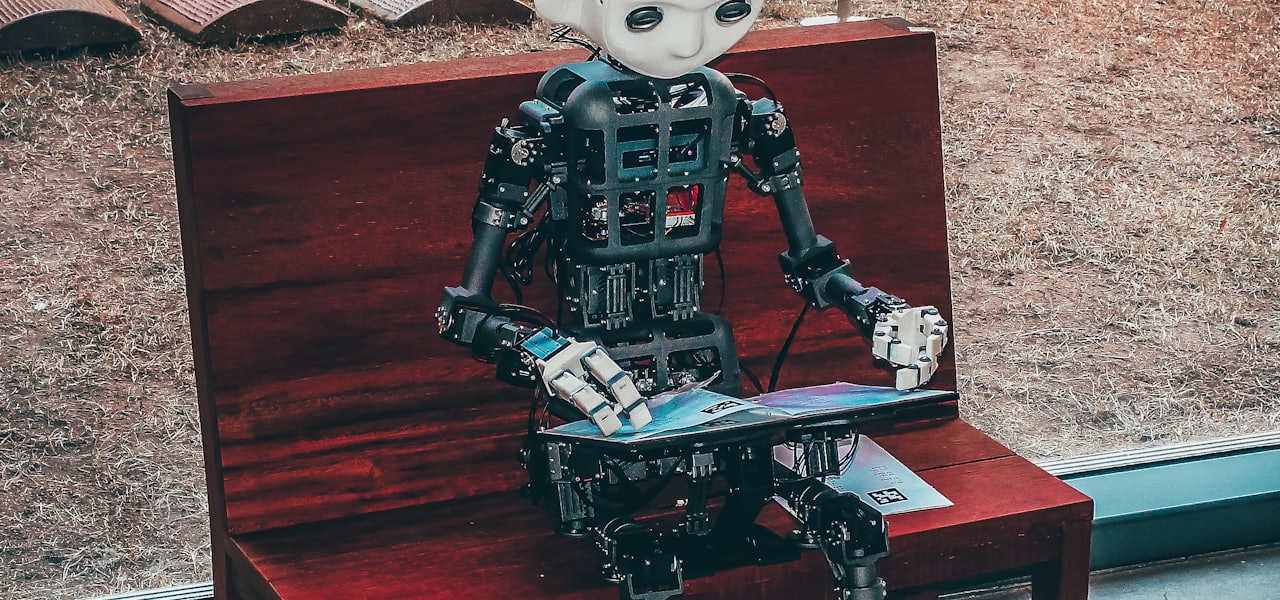
Josef "Sepp" Hochreiter (born 14 February 1967) is a German computer scientist. Since 2018 he has led the Institute for Machine Learning at the Johannes Kepler University of Linz after having led the Institute of Bioinformatics from 2006 to 2018. In 2017 he became the head of the Linz Institute of Technology (LIT) AI Lab. Hochreiter is also a founding director of the Institute of Advanced Research in Artificial Intelligence (IARAI). Previously, he was at Technische Universität Berlin, at University of Colorado Boulder, and at the Technical University of Munich. He is a chair of the Critical Assessment of Massive Data Analysis (CAMDA) conference. Hochreiter has made contributions in the fields of machine learning, deep learning and bioinformatics, most notably the development of the long short-term memory (LSTM) neural network architecture, but also in meta-learning, reinforcement learning and biclustering with application to bioinformatics data. == Scientific career == === Long short-term memory (LSTM) === Hochreiter developed the long short-term memory (LSTM) neural network architecture in his diploma thesis in 1991 leading to the main publication in 1997. LSTM overcomes the problem of numerical instability in training recurrent neural networks (RNNs) that prevents them from learning from long sequences (vanishing or exploding gradient). In 2007, Hochreiter and others successfully applied LSTM with an optimized architecture to very fast protein homology detection without requiring a sequence alignment. LSTM networks have also been used in Google Voice for transcription and search, and in the Google Allo chat app for generating response suggestion with low latency. === Other machine learning contributions === Beyond LSTM, Hochreiter has developed "Flat Minimum Search" to increase the generalization of neural networks and introduced rectified factor networks (RFNs) for sparse coding which have been applied in bioinformatics and genetics. Hochreiter introduced modern Hopfield networks with continuous states and applied them to the task of immune repertoire classification. Hochreiter worked with Jürgen Schmidhuber in the field of reinforcement learning on actor-critic systems that learn by "backpropagation through a model". Hochreiter has been involved in the development of factor analysis methods with application to bioinformatics, including FABIA for biclustering, HapFABIA for detecting short segments of identity by descent and FARMS for preprocessing and summarizing high-density oligonucleotide DNA microarrays to analyze RNA gene expression. In 2006, Hochreiter and others proposed an extension of the support vector machine (SVM), the "Potential Support Vector Machine" (PSVM), which can be applied to non-square kernel matrices and can be used with kernels that are not positive definite. Hochreiter and his collaborators have applied PSVM to feature selection, including gene selection for microarray data. == Awards == Hochreiter was awarded the IEEE CIS Neural Networks Pioneer Prize in 2021 for his work on LSTM.
Version space learning
Version space learning is a logical approach to machine learning, specifically binary classification. Version space learning algorithms search a predefined space of hypotheses, viewed as a set of logical sentences. Formally, the hypothesis space is a disjunction H 1 ∨ H 2 ∨ . . . ∨ H n {\displaystyle H_{1}\lor H_{2}\lor ...\lor H_{n}} (i.e., one or more of hypotheses 1 through n are true). A version space learning algorithm is presented with examples, which it will use to restrict its hypothesis space; for each example x, the hypotheses that are inconsistent with x are removed from the space. This iterative refining of the hypothesis space is called the candidate elimination algorithm, the hypothesis space maintained inside the algorithm, its version space. == The version space algorithm == In settings where there is a generality-ordering on hypotheses, it is possible to represent the version space by two sets of hypotheses: (1) the most specific consistent hypotheses, and (2) the most general consistent hypotheses, where "consistent" indicates agreement with observed data. The most specific hypotheses (i.e., the specific boundary SB) cover the observed positive training examples, and as little of the remaining feature space as possible. These hypotheses, if reduced any further, exclude a positive training example, and hence become inconsistent. These minimal hypotheses essentially constitute a (pessimistic) claim that the true concept is defined just by the positive data already observed: Thus, if a novel (never-before-seen) data point is observed, it should be assumed to be negative. (I.e., if data has not previously been ruled in, then it's ruled out.) The most general hypotheses (i.e., the general boundary GB) cover the observed positive training examples, but also cover as much of the remaining feature space without including any negative training examples. These, if enlarged any further, include a negative training example, and hence become inconsistent. These maximal hypotheses essentially constitute a (optimistic) claim that the true concept is defined just by the negative data already observed: Thus, if a novel (never-before-seen) data point is observed, it should be assumed to be positive. (I.e., if data has not previously been ruled out, then it's ruled in.) Thus, during learning, the version space (which itself is a set – possibly infinite – containing all consistent hypotheses) can be represented by just its lower and upper bounds (maximally general and maximally specific hypothesis sets), and learning operations can be performed just on these representative sets. After learning, classification can be performed on unseen examples by testing the hypothesis learned by the algorithm. If the example is consistent with multiple hypotheses, a majority vote rule can be applied. == Historical background == The notion of version spaces was introduced by Mitchell in the early 1980s as a framework for understanding the basic problem of supervised learning within the context of solution search. Although the basic "candidate elimination" search method that accompanies the version space framework is not a popular learning algorithm, there are some practical implementations that have been developed (e.g., Sverdlik & Reynolds 1992, Hong & Tsang 1997, Dubois & Quafafou 2002). A major drawback of version space learning is its inability to deal with noise: any pair of inconsistent examples can cause the version space to collapse, i.e., become empty, so that classification becomes impossible. One solution of this problem is proposed by Dubois and Quafafou that proposed the Rough Version Space, where rough sets based approximations are used to learn certain and possible hypothesis in the presence of inconsistent data.
Taxonomic database
A taxonomic database is a database created to hold information on biological taxa – for example groups of organisms organized by species name or other taxonomic identifier – for efficient data management and information retrieval. Taxonomic databases are routinely used for the automated construction of biological checklists such as floras and faunas, both for print publication and online; to underpin the operation of web-based species information systems; as a part of biological collection management (for example in museums and herbaria); as well as providing, in some cases, the taxon management component of broader science or biology information systems. They are also a fundamental contribution to the discipline of biodiversity informatics. == Goals == Taxonomic databases digitize scientific biodiversity data and provide access to taxonomic data for research. Taxonomic databases vary in breadth of the groups of taxa and geographical space they seek to include, for example: beetles in a defined region, mammals globally, or all described taxa in the tree of life. A taxonomic database may incorporate organism identifiers (scientific name, author, and – for zoological taxa – year of original publication), synonyms, taxonomic opinions, literature sources or citations, illustrations or photographs, and biological attributes for each taxon (such as geographic distribution, ecology, descriptive information, threatened or vulnerable status, etc.). Some databases, such as the Global Biodiversity Information Facility(GBIF) database and the Barcode of Life Data System, store the DNA barcode of a taxon if one exists (also called the Barcode Index Number (BIN) which may be assigned, for example, by the International Barcode of Life project (iBOL) or UNITE, a database for fungal DNA barcoding). A taxonomic database aims to accurately model the characteristics of interest that are relevant to the organisms which are in scope for the intended coverage and usage of the system. For example, databases of fungi, algae, bryophytes and vascular plants ("higher plants") encode conventions from the International Code of Botanical Nomenclature while their counterparts for animals and most protists encode equivalent rules from the International Code of Zoological Nomenclature. Modelling the relevant taxonomic hierarchy for any taxon is a natural fit with the relational model employed in almost all database systems. Scientific consensus is not reached for all taxon groups, and new species continue to be described; therefore, another goal of taxonomic databases is to aid in resolving conflicts of scientific opinion and unify taxonomy. == History == Possibly the earliest documented management of taxonomic information in computerised form comprised the taxonomic coding system developed by Richard Swartz et al. at the Virginia Institute of Marine Science for the Biota of Chesapeake Bay and described in a published report in 1972. This work led directly or indirectly to other projects with greater profile including the NODC Taxonomic Code system which went through 8 versions before being discontinued in 1996, to be subsumed and transformed into the still current Integrated Taxonomic Information System (ITIS). A number of other taxonomic databases specializing in particular groups of organisms that appeared in the 1970s through to the present jointly contribute to the Species 2000 project, which since 2001 has been partnering with ITIS to produce a combined product, the Catalogue of Life. While the Catalogue of Life currently concentrates on assembling basic name information as a global species checklist, numerous other taxonomic database projects such as Fauna Europaea, the Australian Faunal Directory, and more supply rich ancillary information including descriptions, illustrations, maps, and more. Many taxonomic database projects are currently listed at the TDWG "Biodiversity Information Projects of the World" site. == Issues == The representation of taxonomic information in machine-encodable form raises a number of issues not encountered in other domains, such as variant ways to cite the same species or other taxon name, the same name used for multiple taxa (homonyms), multiple non-current names for the same taxon (synonyms), changes in name and taxon concept definition through time, and more. Non-standardized categories and metadata in taxonomic databases hampers the ability for researchers to analyze the data. One forum that has promoted discussion and possible solutions to these and related problems since 1985 is the Biodiversity Information Standards (TDWG), originally called the Taxonomic Database Working Group. While online databases have great benefits (for example, increased access to taxonomic information), they also have issues such as data integrity risks due to on- and off-line versions and continuous updates, technical access issues due to server or internet outage, and differing capacities for complex queries to extract taxonomic data into lists. As the quantity of information in online taxonomic databases rapidly expands, data aggregation, and the integration and alignment of non-standardized data across databases, is a big challenge in taxonomy and biodiversity informatics.
Enterprise information system
An Enterprise Information System (EIS) is any kind of information system which improves the functions of enterprise business processes through integration. This means typically offering high quality service, dealing with large volumes of data and capable of supporting some large and possibly complex organization or enterprise. An EIS must be able to be used by all parts and all levels of an enterprise. The word enterprise can have various connotations. Frequently the term is used only to refer to very large organizations such as multi-national companies or public-sector organizations. However, the term may be used to mean virtually anything, by virtue of it having become a corporate-speak buzzword. == Purpose == Enterprise information systems provide a technology platform that enables organizations to integrate and coordinate their business processes on a robust foundation. An EIS is currently used in conjunction with customer relationship management and supply chain management to automate business processes. An enterprise information system provides a single system that is central to the organization that ensuring information can be shared across all functional levels and management hierarchies. An EIS can be used to increase business productivity and reduce service cycles, product development cycles and marketing life cycles. It may be used to amalgamate existing applications. Other outcomes include higher operational efficiency and cost savings. Financial value is not usually a direct outcome from the implementation of an enterprise information system. == Design stage == At the design stage the main characteristic of EIS efficiency evaluation is the probability of timely delivery of various messages such as command, service, etc. == Information systems == Enterprise systems create a standard data structure and are invaluable in eliminating the problem of information fragmentation caused by multiple information systems within an organization. An EIS differentiates itself from legacy systems in that it is self-transactional, self-helping and adaptable to general and specialist conditions. Unlike an enterprise information system, legacy systems are limited to department-wide communications. A typical enterprise information system would be housed in one or more data centers, would run enterprise software, and could include applications that typically cross organizational borders such as content management systems.
Concordance (publishing)
A concordance is an alphabetical list of the principal words used in a book or body of work, listing every instance of each word with its immediate context. Historically, concordances have been compiled only for works of special importance, such as the Vedas, Bible, Qur'an or the works of Shakespeare, James Joyce or classical Latin and Greek authors, because of the time, difficulty, and expense involved in creating a concordance in the pre-computer era. A concordance is more than an index, with additional material such as commentary, definitions and topical cross-indexing which makes producing one a labor-intensive process even when assisted by computers. In the precomputing era, search technology was unavailable, and a concordance offered readers of long works such as the Bible something comparable to search results for every word that they would have been likely to search for. Today, the ability to combine the result of queries concerning multiple terms (such as searching for words near other words) has reduced interest in concordance publishing. In addition, mathematical techniques such as latent semantic indexing have been proposed as a means of automatically identifying linguistic information based on word context. A bilingual concordance is a concordance based on aligned parallel text. A topical concordance is a list of subjects that a book covers (usually The Bible), with the immediate context of the coverage of those subjects. Unlike a traditional concordance, the indexed word does not have to appear in the verse. The best-known topical concordance is Nave's Topical Bible. The first Bible concordance was compiled for the Vulgate Bible by Hugh of St Cher (d.1262), who employed 500 friars to assist him. In 1448, Rabbi Mordecai Nathan completed a concordance to the Hebrew Bible. It took him ten years. A concordance to the Greek New Testament was published in 1546 by Sixt Birck, and the Septuagint was done a by Conrad Kircher in 1602. The first concordance to the English Bible was published in 1550 by John Merbecke. According to Cruden, it did not employ the verse numbers devised by Robert Stephens in 1545, but "the pretty large concordance" of Mr Cotton did. Then followed Cruden's Concordance and Strong's Concordance. == Use in linguistics == Concordances are frequently used in linguistics, when studying a text. For example: comparing different usages of the same word analysing keywords analysing word frequencies finding and analysing phrases and idioms finding translations of subsentential elements, e.g. terminology, in bitexts and translation memories creating indexes and word lists (also useful for publishing) Concordancing techniques are widely used in national text corpora such as American National Corpus (ANC), British National Corpus (BNC), and Corpus of Contemporary American English (COCA) available on-line. Stand-alone applications that employ concordancing techniques are known as concordancers or more advanced corpus managers. Some of them have integrated part-of-speech taggers (POS taggers) and enable the user to create their own POS-annotated corpora to conduct various types of searches adopted in corpus linguistics. == Inversion == The reconstruction of the text of some of the Dead Sea Scrolls involved a concordance. Access to some of the scrolls was governed by a "secrecy rule" that allowed only the original International Team or their designates to view the original materials. After the death of Roland de Vaux in 1971, his successors repeatedly refused to even allow the publication of photographs to other scholars. This restriction was circumvented by Martin Abegg in 1991, who used a computer to "invert" a concordance of the missing documents made in the 1950s which had come into the hands of scholars outside of the International Team, to obtain an approximate reconstruction of the original text of 17 of the documents. This was soon followed by the release of the original text of the scrolls.
List of .NET libraries and frameworks
This article contains a list of libraries that can be used in .NET languages. These languages require .NET Framework, Mono, or .NET, which provide a basis for software development, platform independence, language interoperability and extensive framework libraries. Standard Libraries (including the Base Class Library) are not included in this article. == Introduction == Apps created with .NET Framework or .NET run in a software environment known as the Common Language Runtime (CLR), an application virtual machine that provides services such as security, memory management, and exception handling. The framework includes a large class library called Framework Class Library (FCL). Thanks to the hosting virtual machine, different languages that are compliant with the .NET Common Language Infrastructure (CLI) can operate on the same kind of data structures. These languages can therefore use the FCL and other .NET libraries that are also written in one of the CLI compliant languages. When the source code of such languages are compiled, the compiler generates platform-independent code in the Common Intermediate Language (CIL, also referred to as bytecode), which is stored in CLI assemblies. When a .NET app runs, the just-in-time compiler (JIT) turns the CIL code into platform-specific machine code. To improve performance, .NET Framework also comes with the Native Image Generator (NGEN), which performs ahead-of-time compilation to machine code. This architecture provides language interoperability. Each language can use code written in other languages. Calls from one language to another are exactly the same as would be within a single programming language. If a library is written in one CLI language, it can be used in other CLI languages. Moreover, apps that consist only of pure .NET assemblies, can be transferred to any platform that contains an implementation of CLI and run on that platform. For example, apps written using .NET can run on Windows, macOS, and various versions of Linux. .NET apps or their libraries, however, may depend on native platform features, e.g. COM. As such, platform independence of .NET apps depends on the ability to transfer necessary native libraries to target platforms. In 2019, the Windows Forms and Windows Presentation Foundation portions of .NET Framework were made open source. === .NET implementations === There are four primary .NET implementations that are actively developed and maintained: .NET Framework: The original .NET implementation that has existed since 2002. While not yet discontinued, Microsoft does not plan on releasing its next major version, 5.0. Mono: A cross-platform implementation of .NET Framework by Ximian, introduced in 2004. It is free and open-source. It is now developed by Xamarin, a subsidiary of Microsoft. Universal Windows Platform (UWP): An implementation of .NET used for building UWP apps. It's designed to unify development for different targeted types of devices, including PCs, tablets, phablets, phones, and the Xbox. .NET: A cross-platform re-implementation of .NET Framework, introduced in 2016 and initially called .NET Core. It is free and open-source. .NET superseded .NET Framework with the release of .NET 5. Each implementation of .NET includes the following components: One or more runtime environments, e.g. Common Language Runtime (CLR) for .NET Framework and CoreCLR for .NET A class library The .NET Standard is a set of common APIs that are implemented in the Base Class Library of any .NET implementation. The class library of each implementation must implement the .NET Standard, but may also implement additional APIs. Traditionally, .NET apps targeted a certain version of a .NET implementation, e.g. .NET Framework 4.6. Starting with the .NET Standard, an app can target a version of the .NET Standard and then it could be used (without recompiling) by any implementation that supports that level of the standard. This enables portability across different .NET implementations. The following table lists the .NET implementations that adhere to the .NET Standard and the version number at which each implementation became compliant with a given version of .NET Standard. For example, according to this table, .NET Core 3.0 was the first version of .NET Core that adhered to .NET Standard 2.1. This means that any version of .NET Core bigger than 3.0 (e.g. .NET Core 3.1) also adheres to .NET Standard 2.1. == Web frameworks == === ASP.NET === First released in 2002, ASP.NET is an open-source server-side web application framework designed for web development to produce dynamic web pages. It is the successor to Microsoft's Active Server Pages (ASP) technology, built on the Common Language Runtime (CLR). === ASP.NET Core === ASP.NET was completely rewritten in 2016 as a modular web framework, together with other frameworks like Entity Framework. The re-written framework uses the new open-source .NET Compiler Platform (also known by its codename "Roslyn") and is cross platform. The programming models ASP.NET MVC, ASP.NET Web API, and ASP.NET Web Pages (a model using only Razor pages) were merged into a unified MVC 6. === Blazor === Blazor is a free and open-source web framework that enables developers to create Single-page Web apps using C# and HTML in ASP.NET Razor pages ("components"). Blazor is part of the ASP.NET Core framework. Blazor Server apps are hosted on a web server, while Blazor WebAssembly apps are downloaded to the client's web browser before running. In addition, a Blazor Hybrid framework is available with server-based and client-based application components. == Numerical libraries == === Open-source numerical libraries === ==== AForge.NET ==== This is a computer vision and artificial intelligence library. It implements a number of genetic, fuzzy logic and machine learning algorithms with several architectures of artificial neural networks with corresponding training algorithms. ==== ALGLIB ==== This is a cross-platform open source numerical analysis and data processing library. It consists of algorithm collections written in different programming languages (C++, C#, FreePascal, Delphi, VBA) and has dual licensing – commercial and GPL. ==== Math.NET Numerics ==== This library aims to provide methods and algorithms for numerical computations in science, engineering and everyday use. Covered topics include special functions, linear algebra, probability models, random numbers, interpolation, integral transforms and more. MIT/X11 license. ==== Meta.Numerics ==== This is a library for advanced scientific computation in the .NET Framework. ==== ML.NET ==== This is a free software machine learning library. The preview release of ML.NET included transforms for feature engineering like n-gram creation, and learners to handle binary classification, multi-class classification, and regression tasks. Additional ML tasks like anomaly detection and recommendation systems have since been added, and other approaches like deep learning will be included in future versions. === Proprietary numerical libraries === ==== ILNumerics.Net ==== This is a high performance, typesafe numerical array set of classes and functions for general math, FFT and linear algebra. The library, developed for .NET/Mono, aims to provide 32- and 64-bit script-like syntax in C#, 2D & 3D plot controls, and efficient memory management. It is released under GPLv3 or commercial license. ==== Measurement Studio ==== This is an integrated suite of UI controls and class libraries for use in developing test and measurement applications. The analysis class libraries provide various digital signal processing, signal filtering, signal generation, peak detection, and other general mathematical functionality. ==== NMath ==== This is a numerical component library for the .NET platform developed by CenterSpace Software. It includes signal processing (FFT) classes, a linear algebra (LAPACK & BLAS) framework, and a statistics package. == 3D graphics == === Open-source 3D graphics === ==== Open Toolkit (OpenTK) ==== This is a low-level C# binding for OpenGL, OpenGL ES and OpenAL. It runs on Windows, Linux, Mac OS X, BSD, Android and iOS. It can be used standalone or integrated into a GUI. ==== Windows Presentation Foundation (WPF) ==== This is a graphical subsystem for rendering user interfaces, developed by Microsoft. It also contains a 3D rendering engine. In addition, interactive 2D content can be overlaid on 3D surfaces natively. It only runs on Windows operating systems. === Proprietary 3D graphics === ==== Unity ==== This is a cross-platform game engine developed by Unity Technologies and used to develop video games for PC, consoles, mobile devices and websites. == Image processing == === AForge.NET === This is a computer vision and artificial intelligence library. It implements a number of image processing algorithms and filters. It is released under the LGPLv3 and partly GPLv3 license. Majority of the library is written in C# and th
Divide-and-conquer algorithm
In computer science, divide and conquer is an algorithm design paradigm. A divide-and-conquer algorithm recursively breaks down a problem into two or more sub-problems of the same or related type, until these become simple enough to be solved directly. The solutions to the sub-problems are then combined to give a solution to the original problem. The divide-and-conquer technique is the basis of efficient algorithms for many problems, such as sorting (e.g., quicksort, merge sort), multiplying large numbers (e.g., the Karatsuba algorithm), finding the closest pair of points, syntactic analysis (e.g., top-down parsers), SAT solving, and computing the discrete Fourier transform (FFT). Designing efficient divide-and-conquer algorithms can be difficult. As in mathematical induction, it is often necessary to generalize the problem to make it amenable to a recursive solution. The correctness of a divide-and-conquer algorithm is usually proved by mathematical induction, and its computational cost is often determined by solving recurrence relations. == Divide and conquer == The divide-and-conquer paradigm is often used to find an optimal solution of a problem. Its basic idea is to decompose a given problem into two or more similar, but simpler, subproblems, to solve them in turn, and to compose their solutions to solve the given problem. Problems of sufficient simplicity are solved directly. For example, to sort a given list of n natural numbers, split it into two lists of about n/2 numbers each, sort each of them in turn, and interleave both results appropriately to obtain the sorted version of the given list (see the picture). This approach is known as the merge sort algorithm. The name "divide and conquer" is sometimes applied to algorithms that reduce each problem to only one sub-problem, such as the binary search algorithm for finding a record in a sorted list (or its analogue in numerical computing, the bisection algorithm for root finding). These algorithms can be implemented more efficiently than general divide-and-conquer algorithms; in particular, if they use tail recursion, they can be converted into simple loops. Under this broad definition, however, every algorithm that uses recursion or loops could be regarded as a "divide-and-conquer algorithm". Therefore, some authors consider that the name "divide and conquer" should be used only when each problem may generate two or more subproblems. The name decrease and conquer has been proposed instead for the single-subproblem class. An important application of divide and conquer is in optimization, where if the search space is reduced ("pruned") by a constant factor at each step, the overall algorithm has the same asymptotic complexity as the pruning step, with the constant depending on the pruning factor (by summing the geometric series); this is known as prune and search. == Early historical examples == Early examples of these algorithms are primarily decrease and conquer – the original problem is successively broken down into single subproblems, and indeed can be solved iteratively. Binary search, a decrease-and-conquer algorithm where the subproblems are of roughly half the original size, has a long history. While a clear description of the algorithm on computers appeared in 1946 in an article by John Mauchly, the idea of using a sorted list of items to facilitate searching dates back at least as far as Babylonia in 200 BC. Another ancient decrease-and-conquer algorithm is the Euclidean algorithm to compute the greatest common divisor of two numbers by reducing the numbers to smaller and smaller equivalent subproblems, which dates to several centuries BC. An early example of a divide-and-conquer algorithm with multiple subproblems is Gauss's 1805 description of what is now called the Cooley–Tukey fast Fourier transform (FFT) algorithm, although he did not analyze its operation count quantitatively, and FFTs did not become widespread until they were rediscovered over a century later. An early two-subproblem D&C algorithm that was specifically developed for computers and properly analyzed is the merge sort algorithm, invented by John von Neumann in 1945. Another notable example is the algorithm invented by Anatolii A. Karatsuba in 1960 that could multiply two n-digit numbers in O ( n log 2 3 ) {\displaystyle O(n^{\log _{2}3})} operations (in Big O notation). This algorithm disproved Andrey Kolmogorov's 1956 conjecture that Ω ( n 2 ) {\displaystyle \Omega (n^{2})} operations would be required for that task. As another example of a divide-and-conquer algorithm that did not originally involve computers, Donald Knuth gives the method a post office typically uses to route mail: letters are sorted into separate bags for different geographical areas, each of these bags is itself sorted into batches for smaller sub-regions, and so on until they are delivered. This is related to a radix sort, described for punch-card sorting machines as early as 1929. == Advantages == === Solving difficult problems === Divide and conquer is a powerful tool for solving conceptually difficult problems: all it requires is a way of breaking the problem into sub-problems, of solving the trivial cases, and of combining sub-problems to the original problem. Similarly, decrease and conquer only requires reducing the problem to a single smaller problem, such as the classic Tower of Hanoi puzzle, which reduces moving a tower of height n {\displaystyle n} to move a tower of height n − 1 {\displaystyle n-1} . === Algorithm efficiency === The divide-and-conquer paradigm often helps in the discovery of efficient algorithms. It was the key, for example, to Karatsuba's fast multiplication method, the quicksort and mergesort algorithms, the Strassen algorithm for matrix multiplication, and fast Fourier transforms. In all these examples, the D&C approach led to an improvement in the asymptotic cost of the solution. For example, if (a) the base cases have constant-bounded size, the work of splitting the problem and combining the partial solutions is proportional to the problem's size n {\displaystyle n} , and (b) there is a bounded number p {\displaystyle p} of sub-problems of size ~ n p {\displaystyle {\frac {n}{p}}} at each stage, then the cost of the divide-and-conquer algorithm will be O ( n log p n ) {\displaystyle O(n\log _{p}n)} . For other types of divide-and-conquer approaches, running times can also be generalized. For example, when a) the work of splitting the problem and combining the partial solutions take c n {\displaystyle cn} time, where n {\displaystyle n} is the input size and c {\displaystyle c} is some constant; b) when n < 2 {\displaystyle n<2} , the algorithm takes time upper-bounded by c {\displaystyle c} , and c) there are q {\displaystyle q} subproblems where each subproblem has size ~ n 2 {\displaystyle {\frac {n}{2}}} . Then, the running times are as follows: if the number of subproblems q > 2 {\displaystyle q>2} , then the divide-and-conquer algorithm's running time is bounded by O ( n log 2 q ) {\displaystyle O(n^{\log _{2}q})} . if the number of subproblems is exactly one, then the divide-and-conquer algorithm's running time is bounded by O ( n ) {\displaystyle O(n)} . If, instead, the work of splitting the problem and combining the partial solutions take c n 2 {\displaystyle cn^{2}} time, and there are 2 subproblems where each has size n 2 {\displaystyle {\frac {n}{2}}} , then the running time of the divide-and-conquer algorithm is bounded by O ( n 2 ) {\displaystyle O(n^{2})} . === Parallelism === Divide-and-conquer algorithms are naturally adapted for execution in multi-processor machines, especially shared-memory systems where the communication of data between processors does not need to be planned in advance because distinct sub-problems can be executed on different processors. === Memory access === Divide-and-conquer algorithms naturally tend to make efficient use of memory caches. The reason is that once a sub-problem is small enough, it and all its sub-problems can, in principle, be solved within the cache, without accessing the slower main memory. An algorithm designed to exploit the cache in this way is called cache-oblivious, because it does not contain the cache size as an explicit parameter. Moreover, D&C algorithms can be designed for important algorithms (e.g., sorting, FFTs, and matrix multiplication) to be optimal cache-oblivious algorithms–they use the cache in a probably optimal way, in an asymptotic sense, regardless of the cache size. In contrast, the traditional approach to exploiting the cache is blocking, as in loop nest optimization, where the problem is explicitly divided into chunks of the appropriate size—this can also use the cache optimally, but only when the algorithm is tuned for the specific cache sizes of a particular machine. The same advantage exists with regards to other hierarchical storage systems, such as NUMA or virtual memory, as well as for multip